


02/12/2025 00:00:00 - 10/05/2026 23:59:59
Applications closed


Hybrid education

Certificate of Specialized Training
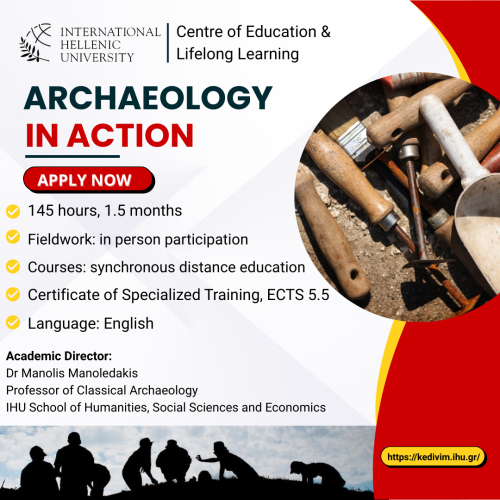
Short description:
The target audience of this programme is very wide and includes both students and graduates who want to enrich their experience in practical archaeology and people who are simply interested in archaeology and fieldwork enthusiasts. The programme invites the participants to engage with archaeology in a dynamic and practical way, participating in all stages of archaeological research at the site "Trapeza of Neo Rysio - Kardia", complemented by optional weekend excursions to major sites of ancient Macedonia, as well as archaeological museums
ECTS: 5,5
Tuition Details:
- 4 weeks (full-time): 2100€ / 2500$
- 2 weeks (part-time): 1200€ / 1400$
- 1 week (part-time): 600€ / 700$
Lodging is not included
- The payment must be made by 30 April 2026.
- Early-entry discount (until 20.2.2026): 10%.
The programme offers a 50% discount to the following categories of applicants who wish to get the ECTs (and thus will attend the courses):
- Greek students
- Graduates of the School of Humanities, Social Sciences and Economics, IHU
Evaluation method:
Evaluation method: Short written examination at the end of the programme
Scientific director:
Professor Manolis Manoledakis (Classical Archaeology)
Academic director:
Professor Manolis Manoledakis
Basic subject:
Social Sciences, Law and Humanities
Subject subcategories:
History/Archaeology
Entry Requirements
- Knowledge of English
- Basic computer skills
Programme's Goal
The Lifelong learning programme “Archaeology in Action”, offered by the International Hellenic University (Thessaloniki), is addressed to people who are interested in archaeology and especially excavation. It combines online lectures with hands-on experience in archaeological fieldwork and laboratory practice. Participants are introduced to all stages of archaeological research, through the ongoing excavation of the International Hellenic University at the site “Trapeza of Neo Rysio – Kardia”, near Thessaloniki. Flexible participation modes (full-time, part-time, non-credit) allow students and enthusiasts to engage with archaeology in a dynamic and practical way, complemented by optional weekend excursions to major sites of ancient Macedonia, as well as archaeological museums, while enjoying the vibrant cultural life, seaside atmosphere, and rich history of Thessaloniki.
Educational objectives
Upon completing the programme, the students will have:
- Participated in professional archaeological fieldwork in Greece
- Applied core excavation methods, including stratigraphic recording and systematic documentation
- Recovered, processed, and managed artefacts and ecofacts from field to storage
- Understood how archaeological sites are located, formed, and preserved within their landscape
- Worked effectively in both field and laboratory environments as part of a multidisciplinary team
- Recognised the importance of context, collaboration, and cultural heritage preservation
Contact Info
To apply, please contact our secretariat: digarch@ihu.edu.gr, tel.: +30 2310807523
For information about lodging and extra costs (e.g. excursions), please contact David Grace, dgrace@ihu.edu.gr
Teaching Staff
The instructors of the programme are archaeologists, members of the International Hellenic University’s excavation:
- Manolis Manoledakis, Professor of Classical Archaeology, Director of the excavation
- Peli Plika, PhD in Classical Archaeology
- Trisevgeni Papadakou, PhD in Prehistoric Archaeology
- Eleni Mentesidou, PhD in Classical Archaeology
- Anastasia Basakyrou, PhD student in Classical Archaeology, tourist guide
Teaching Units - Duration
PRACTICAL APPLICATION – THE WORLD OF AN EXCAVATION (in person participation)
19 days of excavation
2-26 June 2026
Participation modes
- Full-time: 4 weeks (3 weeks fieldwork + 1 week laboratory work)
- Part-time: 2 weeks (1 week fieldwork + 1 week laboratory work)
- Part-time: 1 week (3 days fieldwork + 2 days laboratory work)
Participants may optionally extend their stay with additional weeks of fieldwork and/or laboratory training, depending on availability.
ONLINE COURSES
UNIT 1: INTRODUCTION TO ARCHAEOLOGICAL SITE IDENTIFICATION (optional - online, synchronous distance education)
1 three-hours lesson
Saturday 16 May 2026, 18.00 (EEST)
UNIT 2: ARCHAEOLOGICAL EXCAVATION: THEORY AND METHODOLOGY (optional - online, synchronous distance education)
1 three-hours lesson
Sunday 17 May 2026, 18.00 (EEST)
UNIT 3: BEYOND DIGGING: RETRIEVING, MANAGING AND CURATING ARCHAEOLOGICAL MATERIALS (optional - online, synchronous distance education)
1 three-hours lesson
Saturday 23 May 2026, 18.00 (EEST)
UNIT 4: THE EXCAVATION OF THE ARCHAEOLOGICAL SITE AT NEO RYSIO, THESSALONIKI (mandatory - online, synchronous distance education)
1 three-hours lesson
Sunday 24 May 2026, 18.00 (EEST)
Units 1-3 are optional, while Unit 4 is mandatory for all. Participants who wish to get ECTs must attend all courses and take a short written evaluation at the end of the programme.
OPTIONAL FIELD TRIPS (with a small extra fee)
Saturdays (6 June / 13 June / 20 June / 27 June)
1. Aigai – Pella
2. Petralona cave – Stageira
3. Amphipolis – Philippi
4. Dion – Enipeas canyon
5. Thessaloniki (on weekdays afternoons or Sundays)
All excursions are optional and have extra cost.
Teaching Units Presentation
PRACTICAL APPLICATION – THE WORLD OF EXCAVATION
At the heart of the programme “Archaeology in Action” lies fieldwork, gaining hands-on experience in how archaeologists uncover, document, and preserve the past. Participants develop essential skills through both on-site excavation and post-excavation laboratory work at the International Hellenic University in Thermi. The balance between field and lab activities depends on each participant’s chosen mode of participation.
Fieldwork
The excavation takes place at the Trapeza of Neo Rysio-Kardia, a flat-top settlement dating to the Iron Age, near the university campus. Under the guidance of experienced academic staff, participants will:
- Excavate architectural remains and artefacts from ancient contexts
- Record each find accurately through notes, drawings, measurements, and photography
- Keep an excavation diary and collect samples for laboratory analysis
Students will also experience the interdisciplinary nature of archaeology through visits and demonstrations by specialists such as geoarchaeologists, archaeobotanists, and topographers, gaining a panoramic understanding of the ancient landscape.
Laboratory
After excavation, artefacts undergo a series of steps to transform them into research-ready heritage materials. Students will:
- Wash, sort, mend, and record artefacts such as pottery, bones, and small finds
- Observe conservation specialists restoring and stabilising fragile remains
- Apply soil flotation techniques to recover tiny ecofacts, including charred seeds and micro-artefacts
This stage builds practical expertise in artefact management, ensuring that what is uncovered in the field is preserved, documented, and ready for future study.
Together, the field and laboratory experiences provide participants with a comprehensive understanding of the excavation process, from uncovering the past to preparing artefacts for research and preservation, equipping them with the skills to work with archaeological sites and materials.
Health & Safety Guidelines
Fieldwork is an exciting and rewarding experience, but it takes place outdoors and can be physically demanding. The team works under the summer sun, on uneven terrain, and with excavation tools. For this reason, all participants are asked to take basic precautions to ensure their own safety and comfort, including wearing a hat, sunscreen, sturdy footwear, and appropriate clothing.
If you have any medical condition that may be affected by physical activity or heat, please consult your physician before joining the programme. Our staff will provide guidance and support throughout the excavation, but participants are responsible for following safety instructions and taking care of their personal wellbeing.
ONLINE COURSES
UNIT 1: INTRODUCTION TO ARCHAEOLOGICAL SITE IDENTIFICATION
General description of the course
Archaeological sites range from major settlements and cemeteries to smaller activity areas, agricultural features, and network routes. What defines a site is not its size, but the presence of material traces that help us reconstruct past behaviour and landscape use.
This unit introduces how archaeologists find and recognise sites in their environmental context. Some locations remain visible through standing architecture, while others are known from travellers’ accounts, historical maps, ancient texts, or local oral traditions.
Students will also explore taphonomy, i.e. the natural and human processes that bury, alter, or erase archaeological remains, and how these processes affect site visibility.
Finally, the course presents the main methods used to locate sites today: systematic surface survey, geophysical prospection, LiDAR, drone imagery, coring, fieldwalking, and GIS analysis. These tools allow archaeologists to detect both visible features and hidden subsurface traces.
By combining written evidence with modern survey technologies, students gain a grounded understanding of how archaeological sites are identified within the landscape.
Course goals
By the end of the course, students will be able to:
- Define what constitutes an archaeological site.
- Recognise how historical, textual, cartographic, and oral sources contribute to site discovery.
- Explain the processes that preserve or obscure archaeological remains.
- Apply basic principles of systematic surface survey.
- Identify key methods of modern archaeological prospection.
UNIT 2: ARCHAEOLOGICAL EXCAVATION: THEORY AND METHODOLOGY
General description of the course
This unit introduces students to the core principles and methods of archaeological excavation, linking theoretical knowledge with practical fieldwork skills.
We begin with excavation planning and organisation, including how topographic grids and baulks help maintain spatial and stratigraphic control during digging. Students learn how accurate planning supports the recovery and interpretation of data.
Next, we explore the excavation process itself, which unfolds both vertically, by examining the chronological sequence of layers through stratigraphy, and horizontally, by examining artefact distribution across different contexts. Strong emphasis is placed on systematic documentation, including drawing, photography, and data management, so that information remains reliable for future research.
Finally, the course addresses immovable architectural remains, such as foundations and walls, which must be precisely recorded in situ. Students learn how these features are documented to preserve their context and archaeological significance.
This theoretical foundation prepares students to participate actively and safely in real excavations, applying professional methods on the field.
Course goals
By the end of the course, students will be able to:
- Understand key archaeological excavation methods.
- Use spatial organisation tools to maintain accurate stratigraphic control.
- Interpret vertical and horizontal data to reconstruct site use and chronology.
- Apply systematic documentation techniques.
- Record immovable features with precision.
- Join fieldwork with the knowledge and skills needed for professional practice.
UNIT 3: BEYOND DIGGING: RETRIEVING, MANAGING AND CURATING ARCHAEOLOGICAL MATERIALS
General description of the course:
Excavation produces vast amounts of soil and objects, but how do we turn them into meaningful archaeological information? This unit introduces the techniques and principles that transform finds into knowledge.
The first part focuses on how archaeologists recover different types of information from excavated sediments. Students learn methods such as sifting, flotation, and sampling for microremains or geochemical analysis, which significantly expand both the evidence available to us and the kinds of questions we can ask about the past.
The second part addresses the large quantity of artefacts and ecofacts unearthed during fieldwork — from pottery and bones to metal and stone objects. Students will explore how careful handling, washing, tagging, and storing preserve cultural heritage and ensure long-term research value. They will also learn how systematic recording supports interpretation by maintaining context and provenance.
Together, these topics provide a strong foundation for responsible field practice and help students manage the sensitive and information-rich materials that excavations generate.
Course goals
By the end of the course, students will be able to:
- Identify major categories of artefacts and ecofacts and how they are recovered.
- Apply basic retrieval and sampling methods.
- Process, clean, and record materials correctly and safely.
- Understand why context and documentation matter for interpretation.
- Manage large volumes of archaeological material for storage and future study.
UNIT 4: THE EXCAVATION OF THE ARCHAEOLOGICAL SITE AT NEO RYSIO, THESSALONIKI
General description of the course:
Since 2016, the International Hellenic University has been conducting a systematic excavation at a flat-top site near Neo Rysio, about 17 km south-southeast of Thessaloniki. The site, known as the “Trapeza of Neo Rysio-Kardia,” is a natural hill with a flattened top, forming a characteristic trapezoidal shape between the modern villages of Neo Rysio and Kardia, close to the university’s premises.
Covering about 1.4 hectares at an elevation of 136 metres, the site afforded its inhabitants a remarkable and strategically advantageous view: toward the sea, across a fertile valley with many settlements, and toward the fortress on the nearby mountain.
Excavation results so far reveal a planned settlement dating mainly to the Early Iron Age and Archaic period (approx. 9th–6th centuries BC). Stone-built room complexes, separated by regular streets and alleys, form a densely built town with substantial architecture. Pottery dominates the finds across three building phases, accompanied by limited stone, metal, and ceramic objects, as well as bioarchaeological remains. Most pottery is local, with some imported pieces indicating trade connections.
Together, the architectural and mobile finds shed light on key aspects of the settlement’s domestic and economic life.
This course offers an analytical overview of the site and the results of the university’s ongoing excavation.
Course goal
By the end of the course, students will have gained significant knowledge about the archaeological site at Neo Rysio and its excavation, which will directly support their field and laboratory work during the programme.
FIELD TRIPS (optional, with a small extra fee)
1. Aigai – Pella
This field trip explores the two royal capitals of ancient Macedonia. First, we are going to visit Aigai, located in modern Vergina, and start with a walking tour at the restored building that has been identified with the palace, as well as the nearby theatre, where king Philip II was assassinated. We will continue with a visit in the Museum of the Royal Tombs, where we will examine the burial customs of the Macedonian dynasty and admire funerary offerings such as the golden larnakes. A visit at the new central museum will follow, where we will see a modern exhibition related with the daily and social life of the Macedonians, highlighted by the reconstructed second storey of the palace façade. The trip continues to ancient Pella, the kingdom’s later capital and birthplace of Alexander the Great. There, we will walk through the Hippodamian-planned city, admire its mosaic-decorated houses, and conclude at the Archaeological Museum, home to masterpieces such as the Dionysus-on-panther mosaic.
2. Petralona Cave – Stageira
The second field trip begins in the Halkidiki peninsula with a tour of the Petralona Cave, known for its rich stalactites, stalagmites and significant paleontological remains. Afterwards, the museum visit features fossils, stone tools and the notable Homo heidelbergensis skull. The excursion continues to ancient Stageira, the birthplace of Aristotle, where we are going to roam around the fortification wall, the sanctuaries, the ancient Agora and the acropolis, ending at the “Aristoteleion”, overlooking the Strymonian Gulf and the Aegean.
3. Amphipolis – Philippi
The third field trip continues east to Amphipolis and Philippi, starting with a stop at the iconic Amphipolis Lion and a discussion of its connection to the Kastas tumulus. In Amphipolis we are going to explore the ancient gymnasium, the acropolis, and the museum displaying finds such as the sphinx head from the Kastas tomb and the silver larnax linked to general Brasidas. The journey then moves to Philippi, where we are going to walk by the fortifications, visit the ancient theatre, and admire Roman and Early Christian remains, including the Via Egnatia and the first Christian church in Europe, founded by Apostle Paul.
4. Dion – Enipeas Canyon
The final field trip will be to Dion, the sacred city at the foot of Mount Olympus. We will begin with a walking tour through the archaeological park where we will have the chance to see temples dedicated to various Greek and Egyptian deities and structures from the Roman and Byzantine periods. The tour will continue at the archaeological museum which showcases statues, everyday objects, funerary items and the Dionysus villa impressive mosaic. Before returning to Thessaloniki, we will stop by the Enipeas Canyon to follow a scenic trail rich in vegetation, geological features and small lakes.
5. Thessaloniki
On our Thessaloniki field trips, we are going to discover the city's rich history and culture which start from 316 BC and continue all the way to today. We will have the chance to admire the Roman monuments, such as the Galerius’ complex and the Rotunda, as well as Byzantine structures, such as the churches inscribed in the UNESCO World Heritage List and the surviving fortification walls and citadel. We may visit museums of all kinds, archaeological, contemporary art or photography, which offer deeper insight into Thessaloniki's past and present. These trips would not be complete without a walk by the city's vibrant markets and along the waterfront to enjoy the White Tower and the views of the Thermaic Gulf.
