


02/12/2026 00:00:00 - 10/05/2027 23:59:59
Αιτήσεις σύντομα διαθέσιμες


Μικτή Εκπαίδευση

Πιστοποιητικό Επιμόρφωσης
Σύντομη περιγραφή:
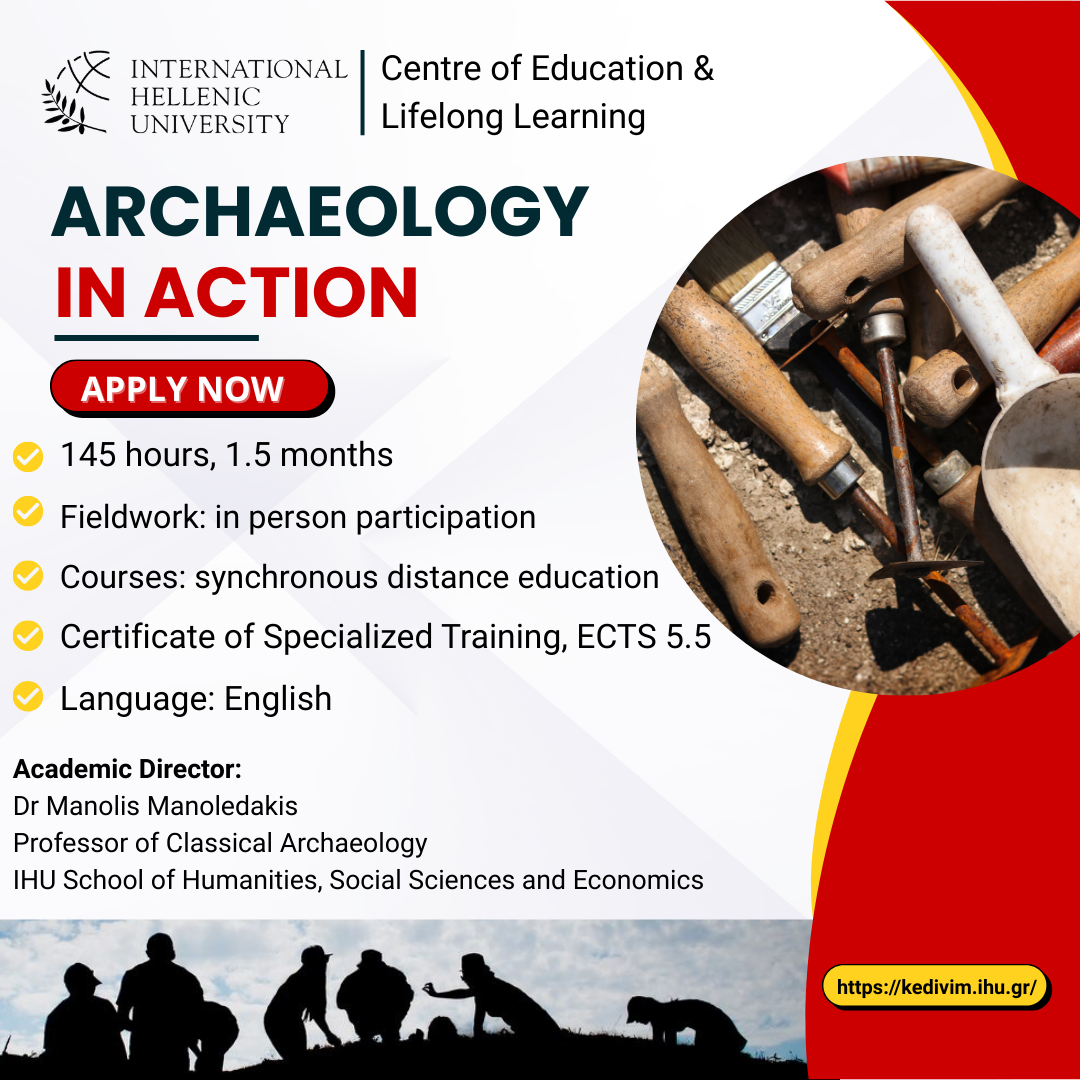
The target audience of this programme is very wide and includes both students and graduates who want to enrich their experience in practical archaeology and people who are simply interested in archaeology and fieldwork enthusiasts. The programme invites the participants to engage with archaeology in a dynamic and practical way, participating in all stages of archaeological research, complemented by optional weekend excursions to major sites of ancient Macedonia, as well as archaeological museums.
Πιστωτικές μονάδες: 5,5
Λεπτομέρειες διδάκτρων:
- 4 weeks (full-time): 2100€ / 2500$
- 2 weeks (part-time): 1200€ / 1400$
- 1 week (part-time): 600€ / 700$
Lodging is not included
- Payment Deadline: 30 April 2027.
- Early-entry discount (until 20.2.2027): 10%.
The programme offers a 50% discount to the following categories of applicants who wish to get the ECTs (and thus will attend the courses):
- Greek students
- Graduates of the School of Humanities, Social Sciences and Economics, IHU
Τρόπος αξιολόγησης των εκπαιδευομένων:
Evaluation method: Short written examination at the end of the programme
Επιστημονικός υπεύθυνος:
Professor Manolis Manoledakis (Classical Archaeology)
Ακαδημαϊκός υπεύθυνος:
Professor Manolis Manoledakis
Βασικό θεματικό πεδίο:
Κοινωνικές Νομικές και Ανθρωπιστικές Επιστήμες
Υποκατηγορίες θεματικών πεδίων:
Ιστορία/Αρχαιολογία
Entry Requirements
- Knowledge of English
- Basic computer skills
Programme's Goal
The Lifelong learning programme “Archaeology in Action”, offered by the International Hellenic University (Thessaloniki), is addressed to people who are interested in archaeology and especially excavation. It combines online lectures with hands-on experience in archaeological fieldwork and laboratory practice. Participants are introduced to all stages of archaeological research, through the ongoing excavation of the International Hellenic University at the site “Trapeza of Neo Rysio – Kardia”, near Thessaloniki. Flexible participation modes (full-time, part-time, non-credit) allow students and enthusiasts to engage with archaeology in a dynamic and practical way, complemented by optional weekend excursions to major sites of ancient Macedonia, as well as archaeological museums, while enjoying the vibrant cultural life, seaside atmosphere, and rich history of Thessaloniki.
Educational objectives
Upon completing the programme, the students will have:
- Participated in professional archaeological fieldwork in Greece
- Applied core excavation methods, including stratigraphic recording and systematic documentation
- Recovered, processed, and managed artefacts and ecofacts from field to storage
- Understood how archaeological sites are located, formed, and preserved within their landscape
- Worked effectively in both field and laboratory environments as part of a multidisciplinary team
- Recognised the importance of context, collaboration, and cultural heritage preservation
Contact Info
For information about lodging and extra costs (e.g. excursions), please contact David Grace, dgrace@ihu.edu.gr
To apply, please contact our secretariat: digarch@ihu.edu.gr, tel.: +30 2310807523
Teaching Staff
The instructors of the programme are archaeologists, members of the International Hellenic University’s excavation:
- Manolis Manoledakis, Professor of Classical Archaeology, Director of the excavation
- Peli Plika, PhD in Classical Archaeology
- Trisevgeni Papadakou, PhD in Prehistoric Archaeology
- Eleni Mentesidou, PhD in Classical Archaeology
- Anastasia Basakyrou, PhD student in Classical Archaeology, tourist guide
Teaching Units - Duration
PRACTICAL APPLICATION – THE WORLD OF AN EXCAVATION (in person participation)
19 days of excavation
31 May – 25 June 2027
Participation modes
- Full-time: 4 weeks (3 weeks fieldwork + 1 week laboratory work)
- Part-time: 2 weeks (1 week fieldwork + 1 week laboratory work)
- Part-time: 1 week (3 days fieldwork + 2 days laboratory work)
Participants may optionally extend their stay with additional weeks of fieldwork and/or laboratory training, depending on availability.
ONLINE COURSES
UNIT 1: INTRODUCTION TO ARCHAEOLOGICAL SITE IDENTIFICATION (optional - online, synchronous distance education)
1 three-hours lesson
Friday 14 May 2027, 18.00 (EEST)
UNIT 2: ARCHAEOLOGICAL EXCAVATION: THEORY AND METHODOLOGY (optional - online, synchronous distance education)
1 three-hours lesson
Saturday 15 May 2027, 18.00 (EEST)
UNIT 3: BEYOND DIGGING: RETRIEVING, MANAGING AND CURATING ARCHAEOLOGICAL MATERIALS (optional - online, synchronous distance education)
1 three-hours lesson
Sunday 16 May 2027, 18.00 (EEST)
UNIT 4: THE EXCAVATION OF THE ARCHAEOLOGICAL SITE AT NEO RYSIO, THESSALONIKI (mandatory - online, synchronous distance education)
1 three-hours lesson
Saturday 22 May 2027, 18.00 (EEST)
All online courses are optional, apart from one, Unit 4
Participants who wish to get ECTs should attend all courses. An evaluation will take place at the end of the programme.
OPTIONAL FIELD TRIPS (with a small extra fee)
Saturdays (12 June / 19 June)
1. Aigai – Pella
2. Dion – Foothills of Mount Olympus and Enipeas Canyon
All excursions are optional and have extra cost.
Teaching Units Presentation
PRACTICAL APPLICATION – THE WORLD OF EXCAVATION
At the heart of the programme “Archaeology in Action” lies fieldwork, gaining hands-on experience in how archaeologists uncover, document, and preserve the past. Participants develop essential skills through both on-site excavation and post-excavation laboratory work at the International Hellenic University in Thermi. The balance between field and lab activities depends on each participant’s chosen mode of participation.
Fieldwork
The excavation takes place at the Trapeza of Neo Rysio-Kardia, a flat-top settlement dating to the Iron Age, near the university campus. Under the guidance of experienced academic staff, participants will:
- Excavate architectural remains and artefacts from ancient contexts
- Record each find accurately through notes, drawings, measurements, and photography
- Keep an excavation diary and collect samples for laboratory analysis
Students will also experience the interdisciplinary nature of archaeology through visits and demonstrations by specialists such as geoarchaeologists, archaeobotanists, and topographers, gaining a panoramic understanding of the ancient landscape.
Laboratory
After excavation, artefacts undergo a series of steps to transform them into research-ready heritage materials. Students will:
- Wash, sort, mend, and record artefacts such as pottery, bones, and small finds
- Observe conservation specialists restoring and stabilising fragile remains
- Apply soil flotation techniques to recover tiny ecofacts, including charred seeds and micro-artefacts
This stage builds practical expertise in artefact management, ensuring that what is uncovered in the field is preserved, documented, and ready for future study.
Together, the field and laboratory experiences provide participants with a comprehensive understanding of the excavation process, from uncovering the past to preparing artefacts for research and preservation, equipping them with the skills to work with archaeological sites and materials.
SECURITY - SAFETY – TIPS – DISCLAIMER
Please note that, while we try to make work comfortable for all of us, the conditions in which we work can be challenging. The hot summer sun in Greece, the tools and the untamed landscape are exciting as much as physically demanding. Every person participating is responsible for taking the necessary precautions, most notably hat, sunscreen, proper shoes and attire. If you have a medical condition, please consult your physician before joining.
ONLINE COURSES
UNIT 1: INTRODUCTION TO ARCHAEOLOGICAL SITE IDENTIFICATION
General description of the course
Archaeological sites range from major settlements and cemeteries to smaller activity areas, agricultural features, and network routes. What defines a site is not its size, but the presence of material traces that help us reconstruct past behaviour and landscape use.
This unit introduces how archaeologists find and recognise sites in their environmental context. Some locations remain visible through standing architecture, while others are known from travellers’ accounts, historical maps, ancient texts, or local oral traditions.
Students will also explore taphonomy, i.e. the natural and human processes that bury, alter, or erase archaeological remains, and how these processes affect site visibility.
Finally, the course presents the main methods used to locate sites today: systematic surface survey, geophysical prospection, LiDAR, drone imagery, coring, fieldwalking, and GIS analysis. These tools allow archaeologists to detect both visible features and hidden subsurface traces.
By combining written evidence with modern survey technologies, students gain a grounded understanding of how archaeological sites are identified within the landscape.
Course goals
By the end of the course, students will be able to:
- Define what constitutes an archaeological site.
- Recognise how historical, textual, cartographic, and oral sources contribute to site discovery.
- Explain the processes that preserve or obscure archaeological remains.
- Apply basic principles of systematic surface survey.
- Identify key methods of modern archaeological prospection.
UNIT 2: ARCHAEOLOGICAL EXCAVATION: THEORY AND METHODOLOGY
General description of the course
This unit introduces students to the core principles and methods of archaeological excavation, linking theoretical knowledge with practical fieldwork skills.
We begin with excavation planning and organisation, including how topographic grids and baulks help maintain spatial and stratigraphic control during digging. Students learn how accurate planning supports the recovery and interpretation of data.
Next, we explore the excavation process itself, which unfolds both vertically, by examining the chronological sequence of layers through stratigraphy, and horizontally, by examining artefact distribution across different contexts. Strong emphasis is placed on systematic documentation, including drawing, photography, and data management, so that information remains reliable for future research.
Finally, the course addresses immovable architectural remains, such as foundations and walls, which must be precisely recorded in situ. Students learn how these features are documented to preserve their context and archaeological significance.
This theoretical foundation prepares students to participate actively and safely in real excavations, applying professional methods on the field.
Course goals
By the end of the course, students will be able to:
- Understand key archaeological excavation methods.
- Use spatial organisation tools to maintain accurate stratigraphic control.
- Interpret vertical and horizontal data to reconstruct site use and chronology.
- Apply systematic documentation techniques.
- Record immovable features with precision.
- Join fieldwork with the knowledge and skills needed for professional practice.
UNIT 3: BEYOND DIGGING: RETRIEVING, MANAGING AND CURATING ARCHAEOLOGICAL MATERIALS
General description of the course:
Excavation produces vast amounts of soil and objects, but how do we turn them into meaningful archaeological information? This unit introduces the techniques and principles that transform finds into knowledge.
The first part focuses on how archaeologists recover different types of information from excavated sediments. Students learn methods such as sifting, flotation, and sampling for microremains or geochemical analysis, which significantly expand both the evidence available to us and the kinds of questions we can ask about the past.
The second part addresses the large quantity of artefacts and ecofacts unearthed during fieldwork — from pottery and bones to metal and stone objects. Students will explore how careful handling, washing, tagging, and storing preserve cultural heritage and ensure long-term research value. They will also learn how systematic recording supports interpretation by maintaining context and provenance.
Together, these topics provide a strong foundation for responsible field practice and help students manage the sensitive and information-rich materials that excavations generate.
Course goals
By the end of the course, students will be able to:
- Identify major categories of artefacts and ecofacts and how they are recovered.
- Apply basic retrieval and sampling methods.
- Process, clean, and record materials correctly and safely.
- Understand why context and documentation matter for interpretation.
- Manage large volumes of archaeological material for storage and future study.
UNIT 4: THE EXCAVATION OF THE ARCHAEOLOGICAL SITE AT NEO RYSIO, THESSALONIKI
General description of the course:
Since 2016, the International Hellenic University has been conducting a systematic excavation at a flat-top site near Neo Rysio, about 17 km south-southeast of Thessaloniki. The site, known as the “Trapeza of Neo Rysio-Kardia,” is a natural hill with a flattened top, forming a characteristic trapezoidal shape between the modern villages of Neo Rysio and Kardia, close to the university’s premises.
Covering about 1.4 hectares at an elevation of 136 metres, the site afforded its inhabitants a remarkable and strategically advantageous view: toward the sea, across a fertile valley with many settlements, and toward the fortress on the nearby mountain.
Excavation results so far reveal a planned settlement dating mainly to the Early Iron Age and Archaic period (approx. 9th–6th centuries BC). Stone-built room complexes, separated by regular streets and alleys, form a densely built town with substantial architecture. Pottery dominates the finds across three building phases, accompanied by limited stone, metal, and ceramic objects, as well as bioarchaeological remains. Most pottery is local, with some imported pieces indicating trade connections.
Together, the architectural and mobile finds shed light on key aspects of the settlement’s domestic and economic life.
This course offers an analytical overview of the site and the results of the university’s ongoing excavation.
Course goal
By the end of the course, students will have gained significant knowledge about the archaeological site at Neo Rysio and its excavation, which will directly support their field and laboratory work during the programme.
FIELD TRIPS (optional, with a small extra fee)
1. Aigai – Pella
This field trip explores the two royal capitals of ancient Macedonia. First, we are going to visit Aigai, located in modern Vergina, and start with a walking tour at the restored building that has been identified with the palace, as well as the nearby theatre, where king Philip II was assassinated. We will continue with a visit in the Museum of the Royal Tombs, where we will examine the burial customs of the Macedonian dynasty and admire funerary offerings such as the golden larnakes. A visit at the new central museum will follow, where we will see a modern exhibition related with the daily and social life of the Macedonians, highlighted by the reconstructed second storey of the palace façade. The trip continues to ancient Pella, the kingdom’s later capital and birthplace of Alexander the Great. There, we will walk through the Hippodamian-planned city, admire its mosaic-decorated houses, and conclude at the Archaeological Museum, home to masterpieces such as the Dionysus-on-panther mosaic.
2. Dion – Foothills of Mount Olympus and Enipeas Canyon
On this field trip, we will explore the rich history and natural landscapes at the foothills of Mount Olympus, the legendary seat of the Olympian Gods. Our journey will begin at Dion, the sacred city of the ancient Macedonians. A walking tour through the archaeological park will reveal ancient temples dedicated to ancient Greek and Egyptian deities, alongside grand Roman and Byzantine ruins. We will also visit the archaeological museum to examine everyday artifacts, statues, and the masterfully preserved Dionysus villa mosaic. Following our historical tour, we will head to the foothills of Mount Olympus for a scenic hike through the Enipeas Canyon. The trail features lush vegetation, unique geological formations, and pristine natural rock pools where you can also swim.
Required attire and preparation tips: You are advised to wear comfortable sportswear and sneakers or hiking shoes with good grip, while also bringing a light jacket and a hat, sunglasses, and sunscreen for open-air sites. Additionally, you may pack a swimsuit and towel if you wish to dive into the canyon rock pools.
